Language:
 ∷
∷

∷
∷
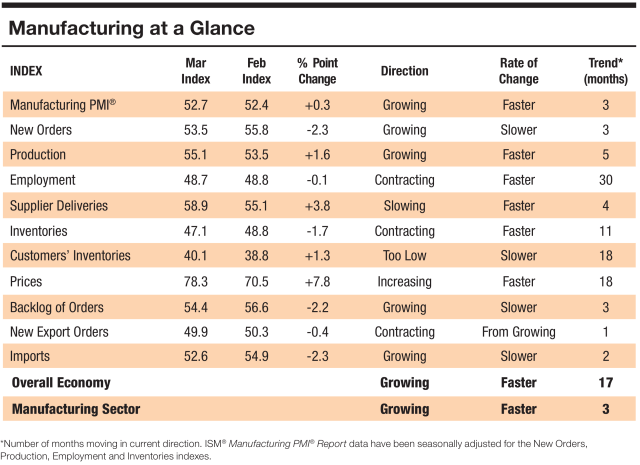
U.S. manufacturing activity expanded in March for the third consecutive month, growing at a slightly faster pace despite mounting geopolitical and pricing pressures. The Institute for Supply Management (ISM) reported that the overall U.S. economy also continued its expansion for the 17th consecutive month.
Susan Spence, chair of the ISM Manufacturing Business Survey Committee, noted that the Manufacturing PMI registered 52.7% in March, a 0.3 percentage-point increase from February’s reading of 52.4%. Spence explained, “In March, U.S. manufacturing activity remained in expansion territory, growing at a slightly faster pace than the month before.” A reading above 50% indicates an expansion in the sector, and the current level corresponds to a 1.8% annualized increase in real gross domestic product (GDP).
Source: Institute for Supply Management
Key manufacturing indicators presented a complex picture at the close of the first quarter. The New Orders Index expanded for the third straight month, though it cooled to 53.5%, down 2.3 percentage points from February. Conversely, the Production Index grew at a faster rate, registering 55.1%, which is 1.6 percentage points higher than the prior month.
The employment picture remained subdued, with the Employment Index contracting for the 30th consecutive month. The index slipped slightly by 0.1 percentage point to 48.7%. Spence said, “55% indicated that managing headcounts remains the norm at their companies, as opposed to hiring.”
Inflationary pressures are increasingly weighing heavily on manufacturers. The Prices Index took another massive leap, registering 78.3% in March, a 7.8 percentage-point jump from February and its highest reading since June 2022.
Spence attributed this surge to multiple factors, noting that the index continues to be driven by “increases in steel and aluminum prices that impact the entire value chain,” as well as “tariffs applied to many imported goods and now increases in petroleum-based products as a result of the recent Middle East conflict.”
Survey respondents expressed a mix of deep frustration and relief regarding trade policy. While an executive in the Food, Beverage & Tobacco Products sector noted “lots of relief from Supreme Court striking down (emergency) tariffs,” others faced new hurdles. A respondent in the Chemical Products sector warned that “ongoing tariff uncertainty is negatively impacting purchasing strategies and cost forecasts.”
The manufacturing sector’s ongoing recovery faces a new headwind following the escalation of the conflict in Iran, which has become a primary concern for supply executives. March marked the first ISM report where panelists cited the Iran war as a new impact on their business. According to Spence, 64% of comments were negative, with about 40% citing the war in the Middle East and roughly 20% pointing to tariffs.
This geopolitical tension is already affecting operations and sentiment. An executive in the Fabricated Metal Products sector observed, “We’re seeing steady increases in activity, but geopolitical issues and the Iran war are already waning sentiment.”
Meanwhile, the Supplier Deliveries Index indicated further slowing for the fourth consecutive month, rising to 58.9%, a 3.8 percentage-point increase from February, signaling extended lead times and supply chain complications. Despite these headwinds, the broader manufacturing economy showed resilience, with 13 manufacturing industries reporting growth in March.
Contact: Mr Zhang
Phone: +86-755-25101495
Tel: +86-755-25101495
Email: john@chip-one.cn
Add: Room 28A, Yinglong Development Center, No. 6025, Shennan Avenue, Tian'an Community, Shatou Street, Futian District, Shenzhen,China